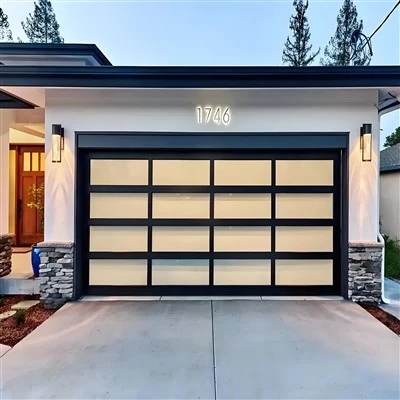
Discover the essential safety systems in modern residential and commercial garage doors, including pinch-resistant designs, infrared photo-eye sensors, and automatic emergency stop mechanisms. Learn how these features prevent injuries and protect property.
When investing in a new garage door for a residential or commercial property, structural durability is only half the equation. Because a garage door is the largest moving object in most buildings, underlying protection mechanisms are critical to preventing operational accidents. According to current industry regulations (such as UL 325 and EN 13241-1), automated entry systems must integrate multi-layered protection.
Below are the three core safety systems standard in modern engineered garage doors.
1. Pinch-Resistant Panel Design (Finger Protection System)
Traditional sectional garage doors feature flat, flush joint interfaces between panels. When the door flexes while opening or closing, these gaps expand and contract, creating severe crush hazards for fingers.
Modern systems utilize pinch-resistant profiles. The male and female joints of the door sections are engineered with curved, interlocking geometries. As the panels rotate through the curved tracking system, the gap remains less than 4mm wide, mechanically pushing fingers away from the hinge line rather than trapping them.
Primary Benefit: Eliminates mechanical crush hazards during manual or automated operation, specifically protecting children and technicians.
2. Infrared Photo-Eye Sensors (Non-Contact Reversal)
For automated overhead doors, non-contact detection is the first line of defense. The system consists of an infrared transmitter and a receiver, mounted on opposite sides of the door tracks, exactly 6 inches (15 cm) above the finished floor line.
The transmitter projects a continuous, invisible infrared light beam. If any obstacle-such as a vehicle bumper, a pet, or equipment-breaks this beam while the door is in motion down, the circuit opens instantly. The garage door opener's logic board processes this signal within milliseconds, immediately stopping the downward travel and reversing the motor to return the door to the fully open position.
Primary Benefit: Prevents the door from ever making physical contact with an obstruction on the floor line.
3. Automatic Emergency Stop & Reversal (Force Sensitivity)
If a non-contact sensor fails or if an obstacle is located out of the direct line of sight of the infrared beam, the system relies on secondary contact force sensitivity. Modern garage door openers monitor the electrical current draw of the motor during operation.
When the bottom edge of the door encounters physical resistance (such as a forgotten cargo box or a sloping floor blockage), the load on the motor increases instantly. This surge in resistance alters the electrical current. The control system interprets this change as an obstruction, executing an automatic emergency stop and reversing the movement within a fraction of a second. Under international safety standards, the downward force required to trigger this reversal must not exceed a strict limit (typically under 15-20 kg of pressure) to prevent crush injuries.
Primary Benefit: Acts as a redundant backup that stops crushing forces even during direct mechanical contact.
Conclusion
Modern garage door safety is defined by redundancy. The combination of passive mechanical geometry (pinch-resistant panels), active non-contact optics (infrared sensors), and reactive electronic monitoring (emergency stop force sensitivity) ensures that heavy industrial and residential doors pose no threat to users. When sourcing garage door components, ensuring compliance with these three safety metrics is essential for long-term operational security.